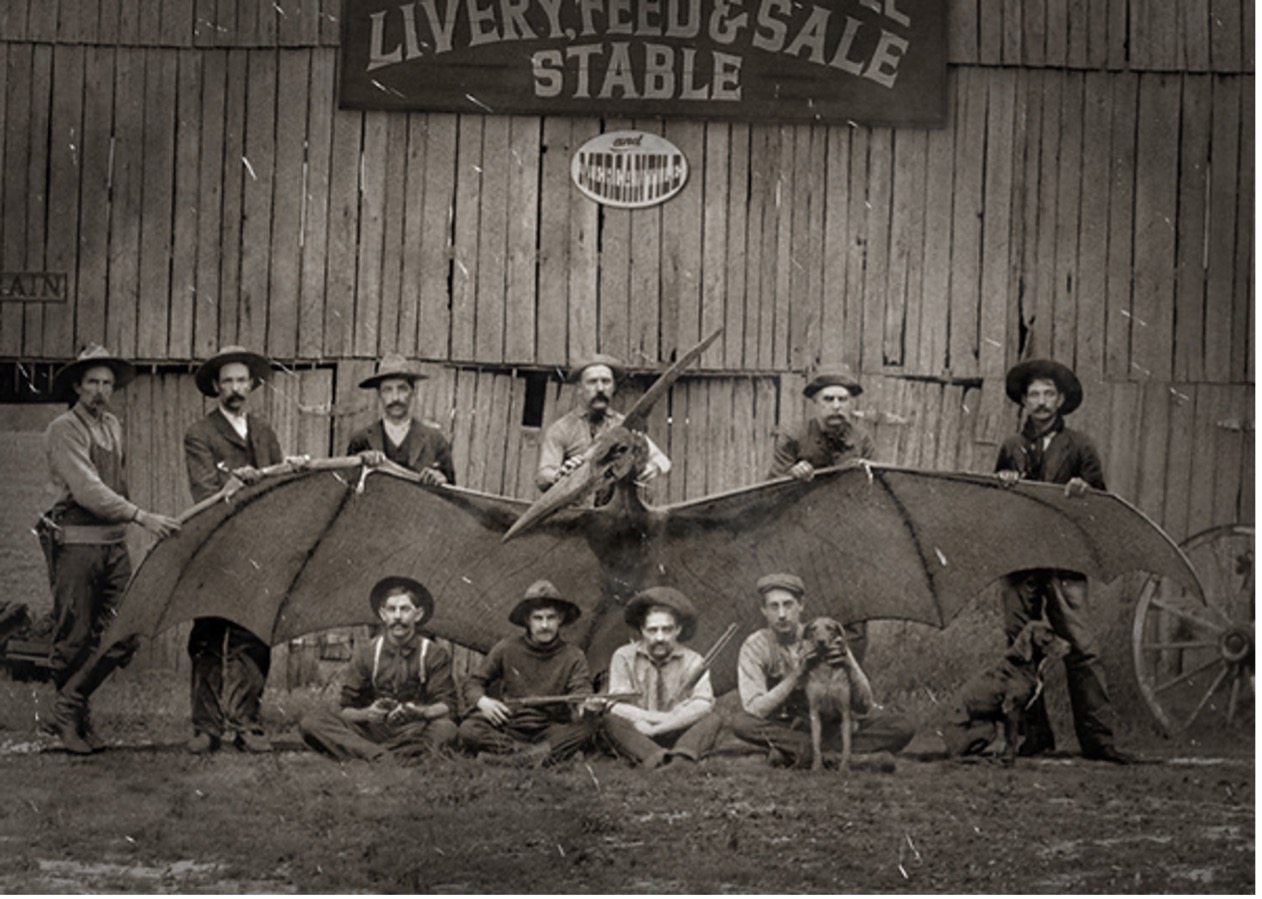
Have you seen this picture of old timers who supposedly shot down this pterosaur?

Popular online photograph of a Pterodactyl (Image Credit: Christopher Smith).[1]
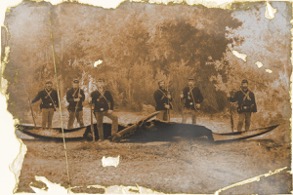
How about this photograph from the Civil War?

Faked pterosaur photograph from the Civil War.[2]
Did these soldiers really shoot down this flying pterosaur, a creature that we’re told went extinct millions of years ago? Well, as convincing as these may look, they’re both fakes. So now we should just dismiss the whole possibility of pterosaurs and giant birds living recently—it’s all just myth, right? Well… maybe not so fast.
Did you know that the vast majority of Native American tribes share thunderbird legends, and many of these accounts document natives being attacked by giant flying birds—especially women and children—as well as deer? In fact, we identified 33 native tribes that have Thunderbird histories.
But here’s the first challenge with these native thunderbird legends: how in the world can giant birds swoop down and carry women, children, or deer when they weigh upwards of 100 pounds? We can answer this by first looking at three eagle species that are well-known for carrying heavy prey: Golden Eagles, Harpy Eagles, and African Crowned Eagles. Did you know that some of these species—which can weigh up to 20 pounds—can carry prey up to 70% of their body weight? Video evidence captures these eagles lifting astonishingly heavy prey — foxes, monkeys, sloths, and even the Chamois, a mountain goat-antelope. Remarkably, they’ve been observed attacking mammals several times their own weight.

Golden Eagle lifts and flies away with a fox.[3]
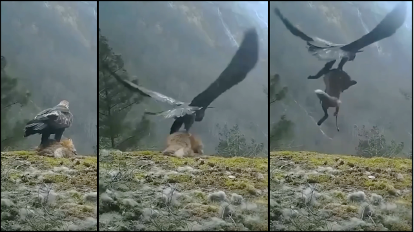
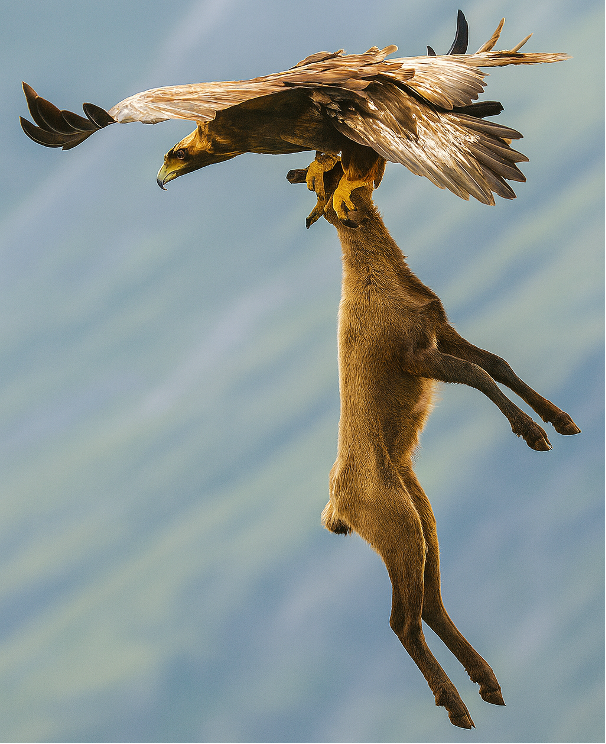
Another video shows a Golden Eagle swooping down, picking up, and flying away with a chamois (Rupicapra rupicapra), a species of goat-antelope. Newborn chamois kids typically weigh 5.5–7.7 pounds and reach 22–33 pounds by the end of their first summer, so this animal certainly weighed in this zone, and judging from its size relative to the eagle, was likely on the heavier side of this range (see below).

Golden Eagle ambushes and carries away Chamois (image upscaled and enhanced, but identical in size and dimension to original).[4]
So, were there really giant birds that lived in the past with humans that could be the creatures described in these thunderbird attacks? Yes, there were. While evolutionists would place these birds before humans lived, the testimony from multiple tribes tells a different story. Some of the possible candidates include Teratornis woodburnensis, Aiolornis incredibilis, or Argentavis magnificens. These massive Ice-Age birds had wingspans that ranged from 13 to 26 feet and some weighed up to 170 pounds. They were certainly capable of carrying small humans and deer.
With wingspans over 35 feet, pterosaurs could also carry heavy prey. For those of us who hold to a Biblical timeline, these creatures are also possible thunderbird candidates. The Biblical perspective holds that pterosaurs lived with man before the Flood, and some after when representatives were brought aboard the Ark, and some continuing long enough after to be recorded in our dragon legends around the world.

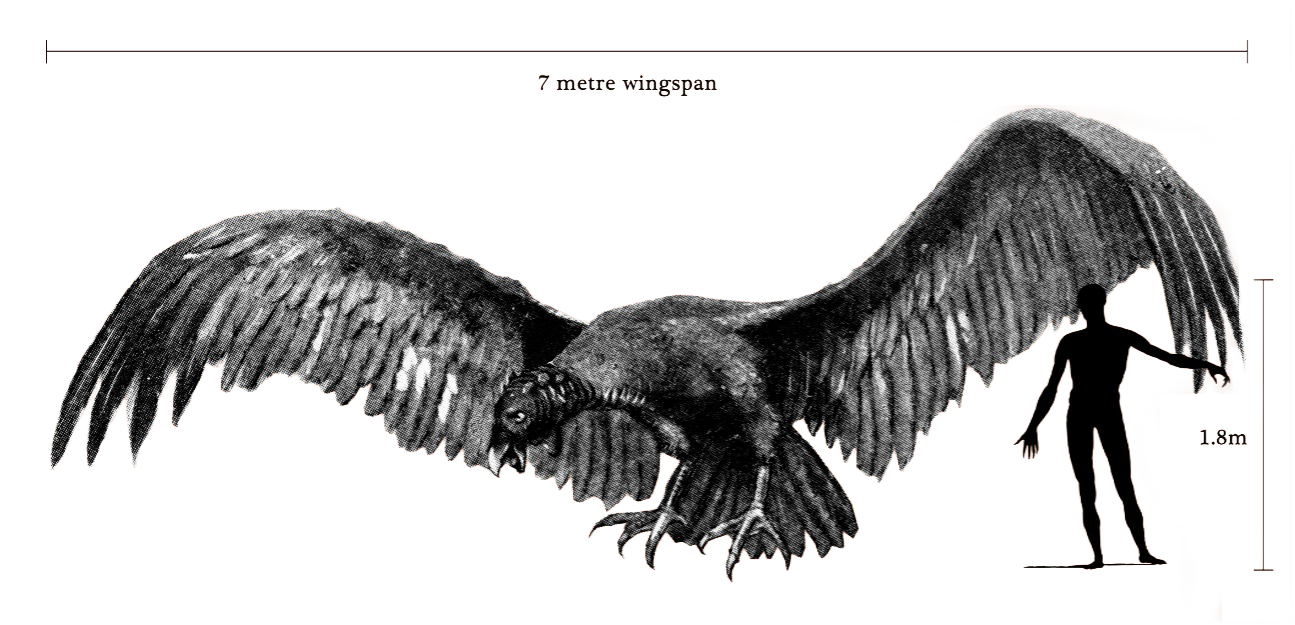
Figure 10. An approximation of the shape and size of Argentavis magnificens compared to a human figure.[5]
While this view is surprising to some, the instant creation of these magnificent flying creatures may be more credible than the evolutionary viewpoint. With no clear evidence of pre-pterosaurs to speak of, and their widespread burial throughout the entire Mesozoic fossil record, it makes more sense that these creatures died in the Flood, staying airborne as long as possible during the year-long Flood until succumbing to their watery fate.
Let’s look at some Native stories to see how they described thunderbirds. But first, consider some of these early Thunderbird drawings and petroglyphs. We have carved Thunderbird prayer sticks, petroglyphs in many states, and some of them even have pterosaur-like features. Some are even shown attacking mammals or people. We have Quetzalcoatl in Mesoamerican cultures, especially the Aztecs. The Inuit have a rich Thunderbird history with carvings and icons everywhere, including thunderbirds attacking large fish or even deer.
One Inuit Thunderbird account documented by the Smithsonian in the 19th century tells about the last pair of Thunderbirds that lived on a mountaintop near Sabotnisky overlooking the Yukon river. The natives called it Tiri-mt-iik’-puk, meaning “the great eagle” and claimed that these massive eagles preyed on large fish, deer, and even humans by looking down upon the village near the water’s edge and swooping down on fishermen in their canoes and carrying them back to their young in the nest. The natives claimed that fishermen would be eaten by the young thunderbirds and the canoe would lie bleaching among the bones and other refuse scattered around the perimeter of the nest. After this went on for years, only the most daring would go upon the great river in view of the birds. One summer day a young hunter lost his wife to one of the birds that swooped down and carried her away to the nest. The hunter pursued, found the nest, and killed young the birds and then the two adults. The author testified that the natives regarded this story as more than just myth, but a real account that could be validated by inspecting the human bones and ribs of old canoes at the nest site. The Natives of the area even have carvings of these Thunderbirds swooping down on large fish and reindeer.
Henry Schoolcraft documented a Dakota Thunderbird account in the 1850s where Natives killed a thunderbird in Little Crow’s village on the Mississippi River. It was reported to have a face like a man, a nose like an eagle’s bill, and a long, slender body. Its wings had four joints to each, which were colored in zigzags, representing what they believed to be lightning. The back of its head was red and rough, resembling a turkey.
How could they know the anatomy of a pterosaur with such detail if they did not actually see one? In fact, a four-jointed wing is exactly how a pterosaur wing would be described, along with a featherless face with large eyes, making it more similar to a human’s face than the face of a feathered eagle. With joints, soft-tissues like eyes, and colors intact, it seems they were looking at a freshly-killed pterosaur, not making up a story about a fossil.
A similar Dakota account was recorded by Hanford Gordon in 1881 where a Thunderbird was killed near Kapdza by the son of Cetan-Wakawa-mani, and they named the place after the creature, calling it “Waki’nyan Tanka”—“Big Thunder.”
An 1898 Apache thunderbird legend records a giant raptor that devoured men, women, and children that was hunted and finally killed by a brave warrior. The historian claimed that the account could be verified by inspecting the actual wing of the monster bird that was of enormous size, with bones as large as a man’s arm, and fragments that were still preserved at Taos.
Two Yaqui elders from Sonora recount the following story of an enormous bird that preyed on humans during a time before their generation:
“Long ago, men, women, and children were carried off by a giant bird of prey with huge talons that lived on the slopes of Otam Kawi, called Skeleton Mountain, in the foothills of the Sierra Madre Occidental above the Rio Yaqui. In those days before pueblos, the Yaquis lived in crude shelters made of mud and branches, cowering in constant fear of the dreadful bird. Every evening someone was carried off toward Skeleton Mountain. On the hillside, villagers found great heaps of bones and skulls of the victims. The bird was impossible to kill, for it had very keen eyesight and soared very high. A young orphan decided to hunt down the fiendish raptor. An old man who lived near Skeleton Mountain advised the boy to hide near the bone piles to ambush the bird. The boy set off with his bow and arrows, dug a hole in the bone field and hid, then ambushed the creature and finally killed it with a club. They claimed that the bones of the terrible bird remained on the hillside to present day.
After the boy returned to his village, he defended his account by promising: “You can cut my neck if the story is not true.” The boy then led a party of elders and warriors from eight villages to see the proof of the pit he had dug and the bird’s skeleton. When the men and soldiers saw the bones of the big bird, they went away contented. The villagers rejoiced, no longer having to worry about danger from above.
This account was independently confirmed by a very similar story from Ruth Giddings in Yaqui Myths and Legends. This account includes the same basic elements: a great bird that hunted humans, generated enough fear among the tribespeople that they did not have outside gatherings, and people living in shelters designed to protect against the great bird. She also reports the bird being killed by a young brave who lost his family to this bird.
On February 12, 1699, Captain Juan Mateo Manje and Jesuits Eusebio Francisco Kino and Adamo Gil recorded in their travel diary that the Pima Indians who lived around the Sonora Desert reported that a “giant monster” lived in a nearby cave until just recently. The natives reported that the monster would fly around and catch as many of their people that it could eat. Their diary records: “One day, after the creature had eaten its fill, some Indians followed it back to its cave. When it was sound asleep they closed the entrance of the cave with wood collected for this occasion; then set it on fire. The creature couldn’t escape and, growling fiercely, died as it was asphyxiated by the flames and smoke.” The Pima also report a story where they killed a similar creature in the pueblo of Oposura using the same strategy. General Don Hernándo Cortés reports sending these bones to Spain.
About 900 BC, the famous Quetzalcoatl or the “Feathered Serpent,” icon emerges in Mesoamerican cultures, especially with the Aztecs. It was often depicted as a large, winged serpent with feathered plumage and avian features. It is typically described as a massive pterosaur-type flying reptile with a body that was serpentine and slender, with possible wings or crest-like features and a long, whip-like tail.
Seneca Chief Cornplanter reported that a great flying creature they called the “Mosquito Monster” was killed and many Cayugas and Onondagas came to view the terrible carcass. The body was larger than a bear’s and its wingspan was as long as three men. Its “talons were as long as arrows and the monstrous beak was lined with sharp teeth.” The footprints were said to be birdlike, about 20 inches long, and one could follow its trail for about 330 feet. It’s interesting that the Chief measured the prints at 20 inches, which is about what we would expect from the fresh prints of a pterosaur with a 17 to 18 foot wingspan.
The Smithsonian records the Cherokee legend about the great Tlanuwa thunderbird:
“On the north bank of Little Tennessee river, in a bend below the mouth of Citico creek, is a high cliff hanging over the water, and about halfway up the face of the rock is a cave with two openings. The rock projects outward above the cave, so that the mouth cannot be seen from above, and it seems impossible to reach the cave either from above or below. There are white streaks in the rock from the cave down to the water. The Cherokee call it Tlanuwa, ‘the place of the Tlanuwa,’ or great mythic hawk.
In the old time, away back soon after the creation, a pair of Tlanuwa had their nest in this cave. The streaks in the rock were made by the droppings from the nest. They were immense birds, larger than any that live now, and very strong and savage. They were forever flying up and down the river, and used to come into the settlements and carry off dogs and even young children playing near the houses. No one could reach the nest to kill them, and when the people tried to shoot them, the arrows only glanced off and were seized and carried away in the talons of the Tlanuwa.
This Cherokee account is incredibly similar to many other accounts from Native American tribes—so similar it seems obvious that they were experiencing the same type of creature! They were immense birds, larger than any alive today, and preyed on deer, dogs, and humans—typically smaller women and children. Could these accounts be describing Aiolornis incredibilis or Argentavis magnificens? Some of these accounts could be describing creatures even larger, like pterosaurs…
Enter the account of the Flying Dragon called the Piasa from the Illiniwek natives of Illinois. The earliest account of the Piasa was recorded in 1673 by Jacques Marquette, a Jesuit missionary who founded Michigan’s first European settlement and mapped the northern portion of the Mississippi River Valley.
Before his team began their journey down the Mississippi in May of 1673, they were warned by the Menominee Indians that they would encounter “horrible monsters, which devoured men and Canoes together.” Sure enough, they soon discovered the massive portrait of the Piasa monster on a limestone wall, likely there as a warning to those traveling down the river. Later in 1825 a rendition of this portrait was made and titled, “FLYING DRAGON.” So whatever this creature was, they regarded it as having dragon-like features. Eleven years later, John Russell, a professor of Greek and Latin at Shurtleff College, recorded the Native American legend about the Piasa. Russel writes:
“The Piasa means ‘The bird which devours men’ in the Illini language. Near the mouth of the stream is cut the figure of an enormous bird, with its wings extended. Many thousand moons before the arrival of the pale faces there existed a bird of such dimensions that he could easily carry off in his talons a full‑grown deer. Having obtained a taste for human flesh he would prey on nothing else. He would dart suddenly upon an Indian, bear him off into one of the caves of the bluff, and devour him.
Such was the state of affairs when Chief Ouatoga fasted in solitude for the space of a whole moon, and prayed. On the last night, the Great Spirit appeared to him in a dream and directed him to select twenty of his bravest warriors. He concealed them to ambush the creatures while he offered himself as bait, placing himself in open view. As he waited he began to chant the death‑song. The Piasa arose and darted down on his victim. Scarcely had the horrid creature reached his prey before every bow was sprung and every arrow was sent quivering to the feather into his body. The Piasa uttered a fearful scream that sounded far over the opposite side of the river and then expired. Ouatoga was unharmed. Not an arrow, not even the talons of the bird, had touched him. The Master of Life, in admiration of Ouatoga’s deed, had held over him an invisible shield.”
Next there’s the dwelling place of the Piasa—a place known as the Bone Cave in Grafton, Illinois. This may be one of the most confirming factors of the Piasa Bird account. Russel and several others report accessing the cave where the Piasa bird lived and finding many human bones strewn about, and mixed together with animal bones.
Russel reports: “My curiosity was principally directed to the examination of a cave, connected with the above tradition as one of those to which the bird had carried his human victims. After a long and perilous climb we reached the cave, which was about fifty feet above the surface of the river. The roof of the cavern was vaulted, and the top was hardly less than twenty feet high. The shape of the cavern was irregular; but so far as I could judge the bottom would average twenty by thirty feet. The floor of the cavern throughout its whole extent was one mass of human bones, skulls, animal bones, and arrowheads were mingled in the utmost confusion. To what depth they extended I was unable to decide; but we dug to the depth of 3 or 4 feet in every part of the cavern, and still we found only bones.” Think about this for a minute… what could explain a random assemblage of mixed animal and human bones better than a cave occupied by a massive flying predator like a pterosaur? And this account was even validated
William McAdams, a geologist and curator of the State Museum at Springfield also backs up this account. In his 1887 book titled Records of the Ancient Races in the Mississippi Valley, McAdams notes that the cave contained many bones—some of them human.
Something’s going on here… First, the Jesuit explorers are warned by natives about a man-eating dragon that lives up the river, then they find a mosaic of the creature on a cliff face, followed by an 1825 drawing of the “flying dragon” portrait the early explorers likely viewed. Then there’s Russel’s detailed account of the native chief, followed by two independent testimonies of the creature’s lair being filled with human and animal bones all mixed together. While some may dismiss this multiple-century account as myth, it sure seems like a pterosaur fits the story well.
We’ve spent most of our time on Thunderbird legends in North America… but did you know that it’s really a worldwide phenomenon?
In China we have the Hai Riyo, a dragon-bird hybrid documented between 206 BC to AD 900. Estimated at 15–25 feet, this creature had a feathered body, two legs, talons, wings, and a long tail. Hai Riyo may reflect cultural memory of a pterosaur or giant bird. Its similarities to other global feathered dragon legends like Quetzalcoatl support a post-Babel dispersion of real flying reptiles remembered and stylized differently in each culture. The consistency of Hai Riyo’s form in temple carvings, Buddhist bestiaries, and Chinese art indicates that it was based on something more than fantasy.
In South Venezuela the Yek’wana have a story of a giant man-eating bat. This story has been with them for several centuries. Clint Vernoy, a missionary to these natives, reported: “The legend is told that a few generations ago there was a large bat that lived at the headwaters of the river in a cave on a large mountain. Periodically it would attack canoes and carry off people as its prey. After quite a few deaths men were chosen to go to the animal’s lair and kill it, which they did. I asked them which mountain it was but there is no consensus, even though I would love to know where that was…Because it was seen to defecate in the river after carrying off humans the Indians would not drink from the Erebato River, they will cross a river 100 yards wide just to get to a small stream that feeds into the river for their drinking water. We showed the Indians pictures of pterodactyls and such and they said, ‘Yes,’ that had to be the giant bat. For them it is not a myth or legend, but a true story of their past that has been handed down through the years.
There’s the Kukulkan of the Mayan, which many associate with the Aztec Quetzalcóatl. This creature could represent the cultural memory of a real, post-Flood flying reptile similar to Quetzalcoatl—possibly a large pterosaur or large bird. Its shared traits with global flying serpent legends suggest that ancient humans across the world recalled a similar kind of creature. Over time, this creature and others like it died out and their images were absorbed into religious systems, preserving biological truth in mythological form.
In Central Africa we have the Kongamato, a flying reptilian creature described by the Kaondé people and others in Zambia, Angola, and the Congo Basin. Its name means “breaker of boats” and it’s the most popular pterosaur-like creature reported from Africa. Witnesses report its wingspan at 4–7 feet, with some tribal legends claiming up to 20–30 feet. It is said to have membranous wings, a leathery, bat-like appearance, two limbs, and a strong aversion to human presence, reportedly attacking boats and capsizing canoes.
In the Assumbo Mountains, Cameroon, we have the Olitiau. The Olitiau was first documented in 1932 during the Percy Sladen Expedition, where zoologist Ivan Sanderson and Gerald Russell encountered a large flying creature with a 10–12 foot wingspan and a 2–3 foot body. With two limbs, leathery wings, and a dark body with a monkey-like face, the Olitiau is often compared to a giant bat or a bat-reptile hybrid. It emerged suddenly from a cave and attacked before vanishing into the rainforest. Indigenous Ipulo folklore already contained stories of similar creatures, suggesting that the encounter was not isolated.
Finally we have the Ropen, a pterosaur-like creature that’s been reported for decades by natives in Papua New Guinea. Since 1935, the Ropen has been one of the most thoroughly investigated modern flying “dragons” in history. It’s described as a large, nocturnal, bat-like creature with a 12 to 30 foot wingspan, a 10 to 15 foot body, and a 10 to 15 foot tail often ending in a diamond-shaped tip. Eyewitnesses, including a U.S. soldier in 1944 and biologist Evelyn Cheesman in 1935, have reported its leathery skin, long tail, and notably, a bioluminescent glow from the abdomen. It’s also fascinating that multiple independent eye witnesses describe and draw the creature as having a tail with “diamond” or “flange” shapes at the end, a feature actually found on known creatures from the fossil record.
Until one of these creatures is actually found, we’ll never know if they still exist today. But our perspective is that we don’t really need this—in fact, it’s quite likely that all giant birds and pterosaurs are gone today. But they lived in the recent past… at least up to a few centuries ago, that much seems clear. There’s just no way that all these reports from independent tribes and explorers from around the world are dreaming up these creatures with their imaginations—especially when they seem to be describing the same types of creatures, oftentimes with quite believable elements in their accounts, such as thunderbirds focusing more on lighter women and children as prey, and two accounts that noted people even avoiding where these animals defecate because they had consumed humans. We also have footprints of recorded lengths and physical descriptions that could match no other creatures besides giant Ice-Age birds or pterosaurs.
Our worldviews guide our perception of the past. The data suggests no clear evolutionary ancestors leading up to these magnificent creatures, their body plans are perfectly designed for flight—even more so in the world before the Flood, which is yet another confirmation of the Bible’s two world epochs. Across the world we have too many accounts about these creatures with too many plausible details that are consistent across these stories. It’s no wonder the Native Americans highly regarded the Thunderbird and gave it such spiritual significance.
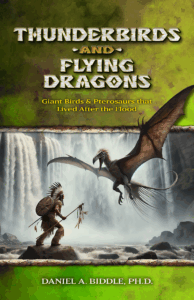
Check out our Thunderbird book that documents the leading thunderbird accounts from the Americas.
[1] This picture is reproduced here on a strictly Fair Use non-commercial educational basis only. See original: https://www.flickr.com/photos/chris_harry/5120294963/
[2] See here for the story: https://skeptoid.com/episodes/4605 and here:
http://www.haxan.com/archived/freakylinks/WWWFRE~1.COM/DIARY/2000/082800~1.HTM;
[3] YouTube: “Diary of the Wild.” www.youtube.com/shorts/GgvyGKodjf0
[4] YouTube: “Perfect Shot: Golden Eagle Ambushes Baby Mountain Goat In the Mountains!” Terra Mater Studios. www.youtube.com/shorts/x6viwr3jCJo?si=AER6fGDrC6zvJl13
[5] Credit: Alamy. Photographer: Chronicle