No products in the cart.
Return To ShopGenesis 6 and the Nephilim: Is the Angel-Hybrid View Correct?
Biblical and Historical Support for the Angel-Hybrid View in Genesis 6
There are four clear historical and Biblical and historical supports for the angel-hybrid view:
Support 1: The Angel-Hybrid View Was Clearly Held by both Jewish Religious Authorities and Texts and Early Christian Fathers
The angel-hybrid interpretation was not a late Christian invention; it was already the dominant Jewish understanding of Genesis 6 in the centuries surrounding the New Testament. Second Temple Jewish works such as 1 Enoch and Jubilees explicitly identify the “sons of God” as angels who took human women and produced giant offspring. The same interpretation appears in the Dead Sea Scrolls, in Philo of Alexandria, and in Josephus, writing near the end of the first century. Scholars commonly describe this as the oldest and prevailing Jewish interpretation of Genesis 6 before and during the apostolic era.
That historical background makes 2 Peter 2:4–5 and Jude 6–7 especially significant. Their references to sinful angels, abandonment of their proper domain, confinement for judgment, and the days immediately preceding Noah’s Flood would have sounded very familiar within this Jewish interpretive world. In fact, Jude draws directly upon traditions also preserved in 1 Enoch. The later Jewish rejection of the angelic interpretation does not become prominent until roughly the second century A.D., after the New Testament period.
The same interpretation then carried directly into the earliest Christian writers. Justin Martyr, Irenaeus, Athenagoras, Clement of Alexandria, Tertullian, and others understood Genesis 6 as describing fallen angels taking human women and producing extraordinary offspring. Patristic scholarship confirms that this angelic interpretation was widespread in early Christianity and only gradually gave way to alternative interpretations in later centuries, especially under Augustine’s influence.
In fact, the Sethite interpretation does not even appear in surviving Christian literature until Julius Africanus in the early third century—well after the apostolic period. It was later developed by Ephrem the Syrian and became widely influential through Augustine in the late fourth and early fifth centuries. Before that shift, the angelic interpretation was the prevailing view in both Second Temple Judaism and the earliest Christian writings.
Support 2: Every Time the “Sons of God” is used in Scripture, it Always Means Angels
When Bene ha-Elohim (the “sons of God”) is used in the Bible, it always means angels. There are no exceptions. See Genesis 6:2, 6:4, Job 1:6, Job 2:1, Job 38:7.
Support 3: Jude 6-7 Connection
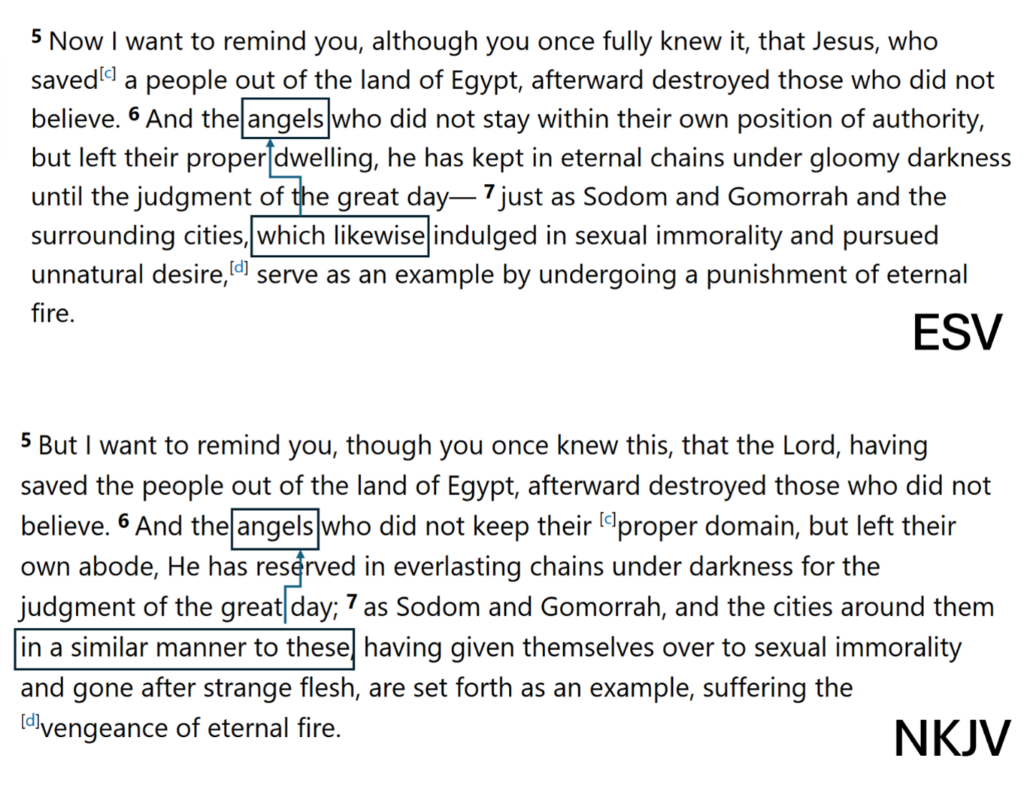
Jude 6-7 is graphically shown below. When Jude 6-7 says that the people in S&G did the same/similar thing (sexual immorality and “strange flesh”) “as these” or “likewise,” (depending on translation) it is necessarily referring to the aforementioned group, which is angels.
 Support 4: 2 Peter 2:4-5 and the Flood
2 Peter 2:4–5 states: “For if God spared not the angels that sinned, but cast them down to hell, and delivered them into chains of darkness, to be reserved unto judgment; and spared not the old world, but saved Noah the eighth person, a preacher of righteousness, bringing in the flood upon the world of the ungodly…” This passage clearly places the context of the angelic rebellion before the Flood and associated with the Flood in a way that is causal:
– Verse 4: “God did not spare angels when they sinned…”
– Verse 5: “and did not spare the ancient world, but preserved Noah… when he brought a flood upon the world of the ungodly.”
Peter places the sin of certain angels immediately before the judgment of Noah’s world. That mirrors the order in Genesis 6:1–8:
sons of God take the daughters of men → Nephilim are present → human wickedness becomes great → God announces the Flood.
This matters because Peter could have chosen many examples of angelic rebellion, yet he connects these sinful angels directly with the pre-Flood world. On the angelic reading, the most obvious Old Testament event fitting that placement is Genesis 6:1–4, where the “sons of God” come to human women.
The argument becomes stronger when 2 Peter is read alongside Jude 6–7, which describes angels who “did not keep their own domain” but “abandoned their proper dwelling,” immediately followed by Sodom and Gomorrah pursuing sexual immorality and “strange flesh.” Jude therefore appears to characterize the angels’ transgression as an improper crossing of created boundaries.
So 2 Peter lays out:
Angels sin → pre-Flood era → Noah/Flood
Which corresponds closely to
sons of God + women → Nephilim → Noah/Flood.
This chronological linkage is one of the strongest reasons that Peter understood the Genesis 6 “sons of God” as the angels whose rebellion contributed to the conditions preceding the Flood.
That historical background makes 2 Peter 2:4–5 and Jude 6–7 especially significant. Their references to sinful angels, abandonment of their proper domain, confinement for judgment, and the days immediately preceding Noah’s Flood would have sounded very familiar within this Jewish interpretive world. In fact, Jude appears to draw directly upon traditions also preserved in 1 Enoch. The later Jewish rejection of the angelic interpretation does not become prominent until roughly the second century A.D., after the New Testament period. The same interpretation then carried directly into the earliest Christian writers. Justin Martyr, Irenaeus, Athenagoras, Clement of Alexandria, Tertullian, and others understood Genesis 6 as describing fallen angels taking human women and producing extraordinary offspring. Patristic scholarship confirms that this angelic interpretation was widespread in early Christianity and only gradually gave way to alternative interpretations in later centuries, especially under Augustine’s influence.